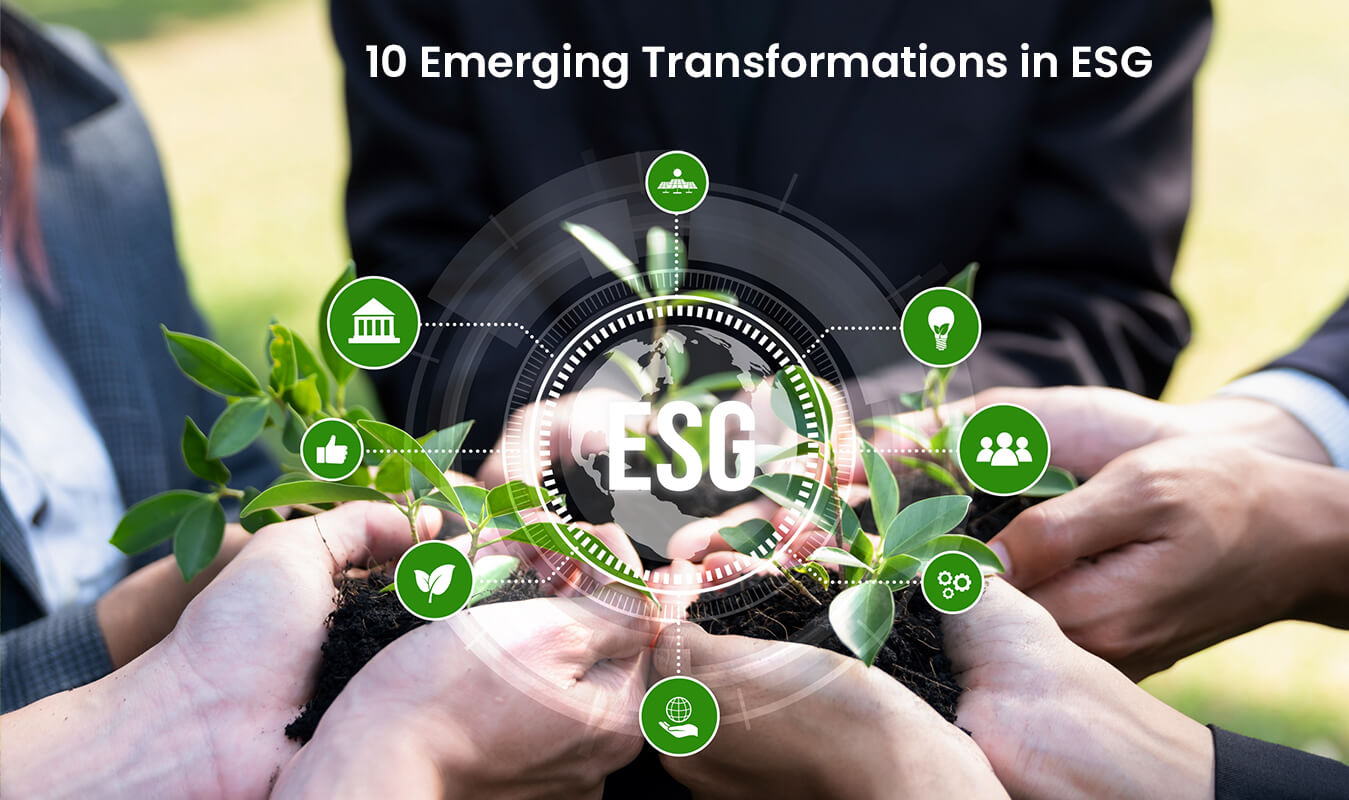
The Next Chapter of ESG: 10 Transformations Driving Sustainable Impact
The ESG and sustainability landscape is evolving from exploration to execution. What was once limited to strategy documents and long-term commitments is now driving real change in daily operations, capital flows, governance frameworks, and supply chain strategies.
Across industries and geographies, a new wave of transformation is taking shape, defining how organizations will integrate ESG principles into the core of their business.
Here are ten emerging shifts in ESG and sustainability that are set to shape the future of business, policy, and society.
- Integrating Climate Risk into Core Operations
Climate risk is no longer treated as a distant or abstract concern. Extreme weather, heat stress, water scarcity, and flooding are directly affecting assets, logistics, insurance costs, and workforce safety. Companies are increasingly embedding climate risk into operational planning, site selection, and business continuity strategies rather than addressing it only in disclosures.
- Double Materiality Reshapes Reporting and Strategy
The concept of double materiality is changing how organizations define what truly matters. Businesses are now expected to assess not only how sustainability issues affect financial performance, but also how their activities impact the environment and society. This shift is pushing companies to integrate ESG more deeply into strategy, risk management, and decision-making.
- Data Quality Overtakes Data Volume
Collecting large volumes of ESG data is no longer enough. Regulators, investors, and auditors are increasingly focused on data accuracy, traceability, and consistency. The emphasis is shifting toward robust data systems, internal controls, and assurance-ready processes that can withstand scrutiny.
- Nature and Biodiversity Enter the Boardroom
Climate is no longer the only environmental priority. Nature-related risks such as biodiversity loss, deforestation, and ecosystem degradation are moving into board-level discussions. Organizations are beginning to recognize that nature loss creates material risks across supply chains, commodity access, and long-term resilience.
- Product-Level Footprints Go Mainstream
Companies are moving beyond corporate-level emissions reporting and focusing on the footprint of individual products and services. Customers, regulators, and business partners increasingly expect transparency at the product level, driving demand for life-cycle assessments, product carbon footprints, and environmental impact labeling.
- Adaptation Gains Equal Importance to Mitigation
While emissions reduction remains critical, organizations are placing greater emphasis on climate adaptation. Preparing assets, supply chains, and communities for unavoidable climate impacts is becoming as important as reducing emissions, particularly in climate-vulnerable regions and sectors.
- Supply Chains Are Mapped for ESG Risk
Supply chains are emerging as one of the largest sources of ESG risk. Companies are investing in supplier mapping, due diligence, and monitoring to identify labor, environmental, and governance risks beyond their direct operations. Transparency across tiers of suppliers is becoming a core expectation.
- Transition Plans Replace Distant Pledges
Long-term net-zero commitments are no longer sufficient on their own. Stakeholders increasingly expect credible transition plans that explain how targets will be met through near-term actions, capital investments, technology choices, and governance oversight. Execution is replacing ambition as the benchmark.
- Proof Takes Priority Over Promises
The tolerance for vague claims and unverified commitments is shrinking. Regulators, investors, and consumers are demanding evidence, metrics, and independently verifiable progress. This shift is driving stronger controls, clearer disclosures, and a move away from performative sustainability.
- Energy Transition Accelerates Despite Volatility
Despite geopolitical uncertainty, price fluctuations, and policy shifts, the transition toward cleaner energy systems continues to advance. Companies are increasingly viewing renewable energy, electrification, and energy efficiency not only as climate actions, but also as long-term cost and resilience strategies.
What do these shifts mean for organizations?
Collectively, these trends mark a deeper transformation. ESG is no longer a standalone agenda handled by a dedicated team it is becoming woven into the very fabric of business operations, finance, procurement, governance, and product innovation.
Organizations that act early will gain a strategic edge: managing risks proactively, staying ahead of regulations, and creating lasting value.
Those that wait may be forced into reactive decisions, responding to external pressures instead of driving their own sustainable transition.
For businesses, policymakers, and investors, understanding these shifts is key to steering the next phase of ESG one where sustainability delivers tangible, long-term impact.