As solar energy adoption accelerates, project developers and investors are constantly seeking ways to maximize energy generation and ensure long-term return on investment.
One of the key decisions during the design stage of any solar power plant is the choice of tracking system; Single Axis or Dual Axis.
Both technologies help solar panels follow the sun’s movement, enhancing the energy output compared to fixed-tilt systems. But which one is right for your project? Let’s explore.
Understanding Solar Trackers
A solar tracker is a mechanical device that adjusts the orientation of photovoltaic (PV) panels throughout the day to keep them aligned with the sun. By optimizing the angle of incidence of sunlight, trackers help panels capture more solar radiation and convert it into higher energy output compared to fixed-tilt systems.
There are two main types of tracking systems used in solar plants:
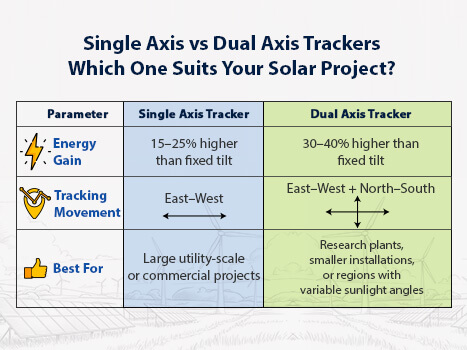
- Single Axis Tracker: Moves panels along one axis is typically east to west, following the sun’s daily path.
- Dual Axis Tracker: Moves panels on two axes that are east–west and north–south, allowing panels to face the sun directly at all times of the year.
️Performance Comparison
Dual axis trackers generate more energy but also come with higher costs and operational complexity. Single axis trackers, on the other hand, strike a practical balance between performance and affordability.
Cost, O&M, and ROI Factors
- Initial Investment: Dual axis trackers require more motors and moving parts, increasing capital costs.
- Maintenance: Single axis systems have simpler mechanisms and lower upkeep.
- ROI: For large-scale installations, the incremental yield from dual axis may not offset its higher cost.
Site Suitability and Environmental Factors
The effectiveness of each tracker type depends heavily on-site conditions, including:
- Latitude: At lower latitudes (closer to the equator), single axis tracking is usually sufficient. Higher latitudes benefit more from dual-axis tracking.
- Terrain: Flat, obstruction-free land supports single-axis systems efficiently. Uneven or constrained plots might need customized or dual-axis arrangements.
- Weather Patterns: In regions with frequent cloud cover or diffuse sunlight, dual-axis trackers can help capture scattered radiation more effectively.
- Wind Load and Soil Conditions: Single-axis systems are generally more stable in high-wind areas and require simpler foundations.
Choosing between a Single Axis and Dual Axis tracker isn’t a one-size-fits-all decision. It depends on site conditions, energy goals, available land, and investment appetite. A well-informed decision, backed by expert consultancy, ensures that every rupee invested translates into higher efficiency and reliable performance.
If you’re planning a new solar project or upgrading an existing one, let our experts guide you with data-backed insights and feasibility evaluations.
📞 Get in touch today to explore which solar tracking system best fits your project.